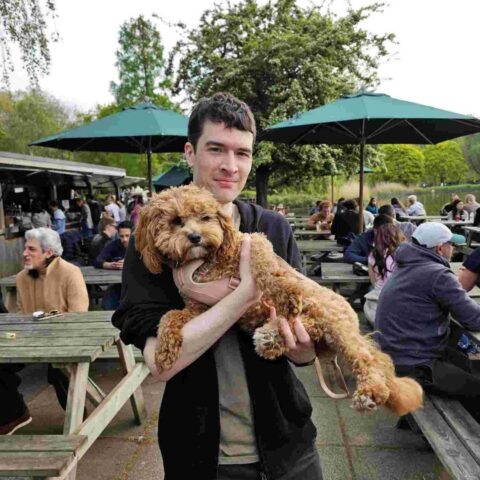
When were you diagnosed and what with?
I was diagnosed with an extremely rare adrenal gland tumour (adrenocortical carcinoma) on Friday, 13th May, 2016. I did take note of the date. I was 23 at the time, and I’m 33 now.
How did you find out you had cancer?
I had a bit of an unconventional route to diagnosis. I experienced a lot of back/side/shoulder pain for a few months. I did go to the GP once, but nothing suspicious was noted and I was advised to do more exercise. The alarm sounded when the pain started to get super bad at nighttime, and one morning I woke up vomiting. I felt so unwell that I just went straight to A&E at the Royal London Hospital. It was a unique time to visit A&E, as it was the first of the large-scale junior doctors’ strikes. It was deserted; I think at one point I was the only person in the waiting room.
There was a consultant at the front desk making sure only the truly ill make it through. After an initial query about why I didn’t just go to my GP, she looked me in the eyes quite intensively and her tone changed suddenly, she said “take a seat, someone will be with you as soon as possible”. A nurse took my blood pressure/pulse and she said, “do you feel your heart racing?” I said, “it’s always been quick”. My heart rate was 150. I was passed through various areas of A&E at lightning speed due to there being no other patients. I had some bloods done and I remember a consultant asking, “do you have a family issue of gallstones?” This took me by surprise as it was the first time I realised that something was actually wrong.
They kept me overnight and I had an ultrasound the next morning. Immediately, as she made contact with my tummy, she said “Oh, there’s something on your liver”. A little alarming. She didn’t seem too concerned though, she said “well it could be scarring on your liver”. I was discharged, but the medical team referred me for a back to back CT + MRI 2 weeks later. Less than 24 hours after that scan, I received a phone call from St Bartholomew’s Hospital in London. The doctor said on the phone “Do you want to come in for a few days so we can take a look at your liver?” I said, “sure, when?” and he replied, “ideally right now. Do you have a family member or friend to come with you?” This sentence went over my head, although being oblivious kept the anxiety down a little.
I met a really nice registrar and she took my (at the time, relatively sparse) medical history, and then said, “let’s look at your scan”. She showed me a massive mass above my kidney and below my liver. It was obvious at this point from her tone that this was a bad tumour. She said it wasn’t clear at this point whether it was cancer or not. I straight up asked “Will it kill me?” She responded explicitly and clearly, saying: “Yes, if it doesn’t come out”.
The next day was the said Friday the 13th. I met my consultant (who I still see after almost 10 years), who described this as a “nasty, nasty tumour”. Almost certainly cancerous, measuring 14x12x10cm. Liver involvement unclear. An annoying complication involved the fact that it had started growing up the IVC (biggest vein in the body), which made surgery difficult. I also had two lovely pulmonary embolisms which needed immediate treatment. The NHS did their thing and within a week I had another CT scan, a full body PET scan, some weird nuclear medicine kidney scan, 24 urine test and a significant amount of blood tests. I had a large and risky surgery a few weeks later, lost my right kidney, right adrenal gland and now here I am, almost 10 years later.
What did you think and feel when you were diagnosed?
I had a feeling something was wrong for quite a few weeks, so in one sense I was relieved that I wasn’t going crazy. It was a particularly scary period in the few weeks after diagnosis, as it wasn’t clear if I was going to be able to have surgery or not. It was a great excuse to not do any uni work, though.
How did the people around you react?
I found telling people about it worse than actually being told the diagnosis myself. Some friends came to see me and never saw me again, but some went above and beyond what I had ever expected of them. I appreciated humour; one friend said, “You had to go get a rare cancer didn’t you, that’s totally something you would do”. That’s totally me.
What treatment did you have?
Surgery is the only curative treatment for adrenocortical carcinoma (ACC) and it was all taken out. I then had radiotherapy to my right flank, which is usually difficult because of the risk of kidney damage. Luckily, I didn’t have one there anymore! I was also on an oral chemotherapy, called mitotane, the only licensed drug for ACC. It’s nasty stuff, I lasted 18 months before coming off.
How did you feel through treatment?
It was a rollercoaster. Pre-surgery I was 54kg, and one year after surgery I was 74kg. I had an insane amount of post-op pain, and nausea from the mitotane. Lots of fatigue, thirst, gastro issues. Scanxiety and fear of recurrence was rough for the first few years.
What happened after treatment finished?
The main side effect of the surgery + follow up mitotane is that the remaining adrenal gland effectively dies. This is common to almost everyone who goes through treatment for ACC; you are subsequently diagnosed with primary adrenal insufficiency/Addison’s disease. This means you have to take hydrocortisone 3 times a day for the rest of your life, with a backup emergency injection in case things get rough. I got used to it quite quickly, but it is the most life changing aspect of the whole thing.
I was also lucky enough to get diagnosed with a completely unrelated rare form of kidney disease. This is really problematic if you have only one kidney remaining. That alone has caused a lot of issues but it’s remained stable for the past few years. In addition, my pancreas somehow got caught up in all the drama too, so now I have to take enzymes whenever I eat.
At no point did the tumour reappear. This was unexpected because of how aggressive it was on paper, but I’m pretty happy it didn’t come back!
At the time of diagnosis I was working on a PhD. I managed to complete it in 2020, just as the first covid lockdown started. I was then out of work for about 2 years, mainly due to being on the clinically extremely vulnerable list. I started a part time job in 2022, and I’m now in a full time job.
I don’t have any more treatment for the actual cancer, but I will be on steroids and other stuff likely for life which still needs input from my endocrine team.
How did you get involved with Shine?
I was sent details about the Shine Connect conference by my nurse. I thought I’d might as well go. I then started attending the meet ups in London.
What difference has Shine made to you?
One of the most uncomfortable things about being diagnosed and going through all the treatment is that I was in a really isolated age group. None of my friends or family had gone through anything similar, so I got to experience a lot of pity, people not knowing what to say or do. Shine was sort of a reset for me, I could talk to other people about it not in the scary or sad way but in the matter of fact funny way. I could complain about cancer related things and others could say “yeh, me too” instead of “oh that must be so bad for you” or referencing various late relatives. That made more of a difference than any drug or therapy did.
How do you feel now about your experiences? What‘s been the biggest change you’ve faced?
There was a lot of uncertainty for the first few years in terms of recurrence and kidney disease and I’m in a much happier place now. The biggest change is physical, like suddenly I was handed a different body that doesn’t work as well and has loads of annoying issues.
If you could give one piece of advice to yourself before your diagnosis, what would it be?
No need to worry about anything, it’s going to be okay either way. Also, buy loads of bitcoin.

If you’d like to share your own personal experience, please get in touch. We’d love to hear from you!